
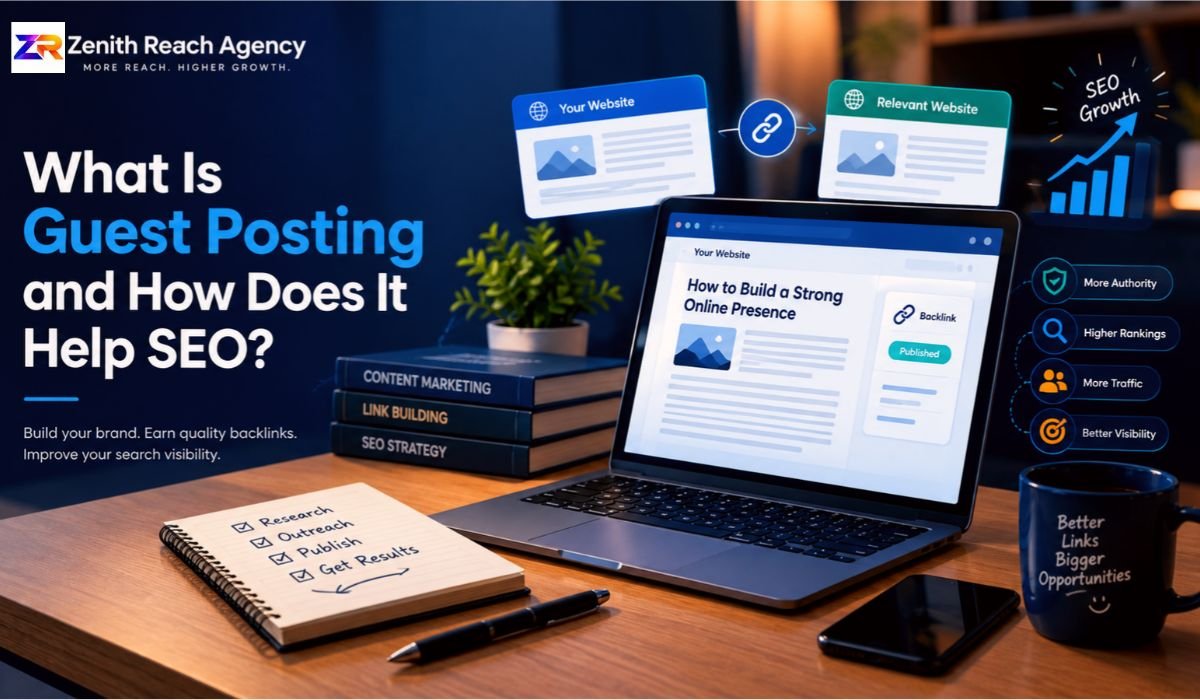
Guest posting is a content marketing and SEO outreach strategy where you contribute an article to another website in your industry or niche. In return, the publisher may allow you to include a relevant link to your website, depending on its editorial and linking policies.
For businesses, agencies, and website owners, guest posting can be more than simply acquiring a backlink. A well-chosen publication can put your brand in front of a relevant audience, introduce your expertise to potential customers, and contribute to a broader SEO and content marketing strategy.
However, not every guest post opportunity has the same value. Publishing an article on a completely unrelated website simply because it has a high domain metric is not the approach businesses should rely on. Relevance, content quality, audience, website standards, and the purpose of the placement all matter.
In this guide, we’ll explain what guest posting is, how it can support SEO, how to evaluate opportunities, and what businesses should consider before starting a guest posting campaign.
What Is Guest Posting?
Guest posting, also called guest blogging, means creating an original article for publication on another website.
For example, imagine that you run a company providing home improvement services. You may contribute a useful article about home renovation planning to a relevant home improvement, construction, or property website.
The article should be written for that website’s audience rather than simply being created to place a link.
Depending on the publisher’s guidelines, your contribution may include:
- A link to your website
- A link to a relevant service page
- A reference to your brand
- An author bio
- Useful information related to your industry
The exact linking options depend on the publisher and its editorial policies.
A good guest post should make sense even without the backlink. If readers find the article genuinely useful, the placement has value beyond SEO.

How Does Guest Posting Work?
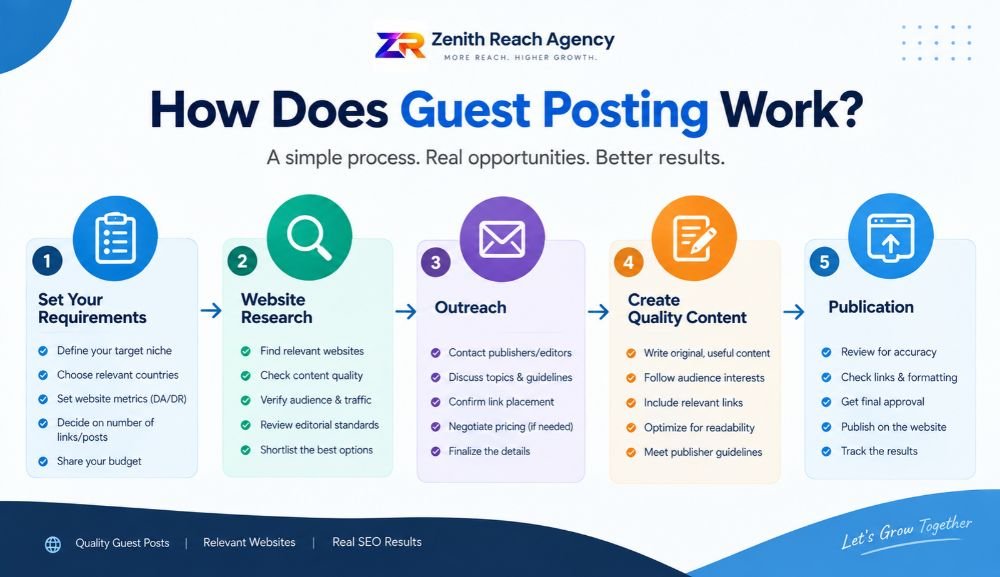
A typical guest posting campaign involves several stages.
1. Define Your Target
Before contacting websites, determine what you want from the campaign.
For example:
- Your target industry or niche
- The type of websites you want to appear on
- Target countries
- Preferred website metrics
- Number of placements
- Pages you want to promote
- Available budget
Having clear requirements makes the outreach process much more organized.
2. Find Relevant Websites
The next step is identifying websites that are relevant to your industry.
Instead of looking only at metrics such as DA or DR, consider the site’s actual content.
Ask:
- Does the website regularly publish content related to your niche?
- Does it appear to have a genuine audience?
- Is the content professionally maintained?
- Are the topics relevant to your target customers?
- Does the website have reasonable editorial standards?
A relevant website can make more sense for your campaign than a high-metric website with no meaningful connection to your industry.
3. Contact the Publisher
Once suitable websites have been identified, outreach begins.
This usually involves contacting website owners, editors, or publishers and discussing:
- Guest post opportunities
- Available topics
- Publishing requirements
- Link placement options
- Pricing, where applicable
- Content guidelines
- Expected turnaround time
Professional communication is important because successful outreach is often built around relationships rather than one-time transactions.
4. Create Useful Content
After an opportunity is confirmed, the article should be created according to the publisher’s requirements.
The content should be:
- Original
- Useful
- Relevant to the audience
- Easy to read
- Properly structured
- Factually responsible
- Naturally written
The goal should not be to write an article around a backlink. The goal should be to create an article that deserves to be published.
5. Review and Publish
Before publication, review the article for accuracy, readability, links, formatting, and compliance with the publisher’s guidelines.
Once approved, the publisher publishes the content according to the agreed terms.
How Does Guest Posting Help SEO?
Guest posting can support SEO in several ways, although results depend heavily on the quality and relevance of the websites and content involved.
1. It Can Help You Earn Relevant Backlinks
One of the main reasons businesses use guest posting is to earn links from other websites.
A relevant backlink can help search engines discover relationships between websites and content. However, links should be acquired and used in accordance with search engine guidelines.
The quality and context of a link matter more than simply collecting a large number of links.
For that reason, a campaign focused on relevant opportunities is generally more sensible than one focused only on link quantity.
2. It Can Increase Brand Exposure
A guest post puts your company in front of people who may not have discovered your website otherwise.
For example, if an SEO agency contributes a useful article to a digital marketing publication, readers interested in SEO may become familiar with that agency.
Even when a reader does not click the link immediately, the brand exposure can still be valuable.
3. It Can Bring Referral Traffic
A useful article can generate visitors directly from the publisher’s website.
This is one reason website selection matters.
A website with an audience that actually cares about your subject can potentially send more relevant visitors than a website chosen only because of a high SEO metric.
4. It Can Support Your Content Strategy
Guest posting can also expand the reach of your expertise.
Instead of publishing everything only on your own website, you can contribute useful insights to publications that already have audiences in your industry.
This gives your brand additional places where people can discover your expertise.
5. It Can Support Professional Authority
Consistently contributing useful information to relevant publications can help establish your brand as an active participant in its industry.
This is especially useful for businesses that want to demonstrate knowledge around specific subjects.
However, authority should be built through genuinely useful contributions rather than simply publishing as many articles as possible.
Does Every Guest Post Help SEO?
No.
Simply publishing an article on another website does not automatically guarantee better rankings.
The value of a guest post can vary significantly depending on factors such as:
- Topical relevance
- Website quality
- Audience relevance
- Content quality
- Link context
- Editorial standards
- Website maintenance
- Overall campaign strategy
For example, a website about construction may be a logical publishing opportunity for a roofing company.
A completely unrelated website may not provide the same contextual value, even if its SEO metrics appear impressive.
This is why relevance should be one of the first things you evaluate when reviewing guest posting opportunities.
What Makes a Good Guest Posting Website?
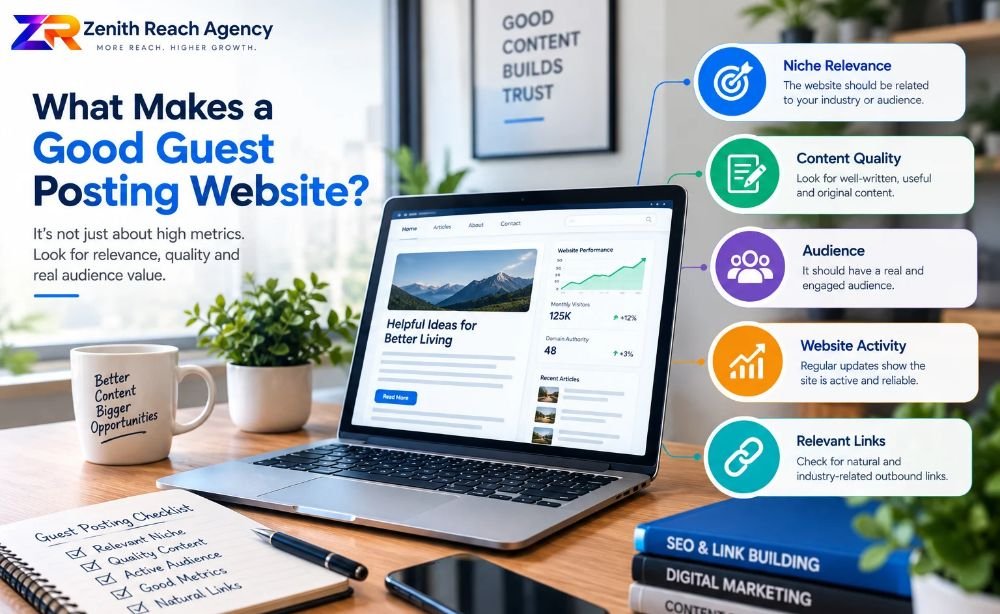
Before accepting a website for your campaign, look beyond one metric.
Topical Relevance
The website should have a meaningful relationship with your industry, service, product, or target audience.
Quality Content
Look at the site’s recent articles.
Are they well-written and useful?
Do the articles provide genuine information, or does the website appear to publish almost anything submitted to it?
Real Audience
Consider whether the website appears to attract people who are actually interested in its subject matter.
Relevant visitors can be valuable for both visibility and referral traffic.
Consistent Publishing
An active website with regularly updated content is generally easier to evaluate than a website that appears abandoned.
Sensible Outbound Links
Review some existing articles and links.
If a website links to a large number of unrelated or questionable destinations, that should be considered before using it for a campaign.
Suitable Editorial Standards
A publisher with clear content requirements and quality control can be preferable to a website that publishes every submission without review.
Guest Posting vs. Link Insertion
Guest posting and link insertion are related link-building methods, but they are not the same.
With guest posting, you create a new article that is published on another website.
With a link insertion, a relevant link is added to an existing article or page, where the publisher considers the link appropriate.
Guest Posting
- New article
- Opportunity to introduce a topic
- Can showcase your expertise
- Can include a relevant link where permitted
- Useful for content and brand exposure
Link Insertion
- Uses existing content
- Link is placed within an already published article or page
- Can be useful when the existing content is highly relevant
- Usually requires finding a suitable existing page
Both approaches can have a place in a broader SEO outreach strategy. The right option depends on the campaign’s goals and available opportunities.
Common Guest Posting Mistakes to Avoid
Choosing Websites Only by DA or DR
DA and DR can be useful metrics for research, but they should not be the only criteria.
A website’s niche, content quality, relevance, audience, and overall condition should also be reviewed.
Using the Same Article Everywhere
Publishing identical content across multiple websites can make your campaign look low-effort.
Each contribution should be created specifically for the intended publication and its audience.
Overusing Exact-Match Anchor Text
Links should fit naturally within the content.
Using the same commercial keyword as anchor text repeatedly across a campaign is not a sensible way to build a natural-looking link profile.
Ignoring the Audience
An article should be useful to the readers of the publication.
If you write only for search engines and ignore the audience, the content may provide little value.
Focusing Only on Quantity
More links do not automatically mean a better campaign.
A smaller number of well-selected, relevant opportunities can be more meaningful than a large collection of unrelated placements.
One common mistake is treating guest posting purely as a way to acquire links instead of focusing on useful content and relevant websites. Businesses should also follow Google’s spam policies when building links and publishing content.
Best Practices for a Successful Guest Posting Strategy
A strong guest posting campaign starts with proper research.
Here are some practical guidelines:
- Start with relevance.
Prioritize websites that make sense for your industry and audience. - Research every website before outreach.
Look at recent articles, topics, quality, activity, and outbound links. - Create content for people first.
Make every article useful enough to stand on its own. - Keep links natural and relevant.
Only link where the destination genuinely adds value to the reader. - Build publisher relationships.
Good communication can lead to more opportunities in the future. - Track your placements.
Maintain records of publication URLs, target pages, anchor text, dates, and campaign details. - Diversify your SEO strategy.
Guest posting should be one component of a broader SEO and content strategy rather than the only activity. - Google Search Central – SEO Starter Guide
A successful guest posting strategy should be part of a broader SEO approach that focuses on useful content, a good user experience, and building a trustworthy online presence. Google’s SEO Starter Guide also provides useful guidance on creating content that can help search engines understand your website.
How to Start a Guest Posting Campaign
If you’re planning your first campaign, start by creating a simple requirements list.
Include:
- Target niche
- Target countries
- Preferred website metrics
- Number of placements
- Guest post or link insertion
- Target URLs
- Preferred anchor text
- Budget
- Any specific website requirements
Once these details are clear, you can begin researching relevant publishers and contacting them with a professional outreach message.
The more specific your requirements are, the easier it becomes to identify opportunities that actually fit your campaign.
Final Thoughts
Guest posting can be a useful part of an SEO and digital marketing strategy when it is approached with the right priorities.
The goal should not simply be to publish an article somewhere and collect a backlink. A stronger approach is to find relevant publications, create genuinely useful content, build professional publisher relationships, and select opportunities that make sense for your business and audience.
Whether you’re a business owner managing your own SEO or an agency handling campaigns for multiple clients, quality, relevance, and consistency should remain at the center of your guest posting strategy.
Looking for Relevant Guest Posting Opportunities?
At Zenith Reach Agency, we help businesses and digital marketing agencies explore relevant guest posting, link insertion, and SEO outreach opportunities.
We work with publishers and website owners across different niches and can help you explore opportunities based on your target niche, preferred website metrics, number of links, target countries, and budget.
Have a guest posting or link building requirement?
Start Your Link Building Campaign
Or contact us at zain@zenithreachagency.com

Leave a Reply