

Building backlinks is not just about getting more links than your competitors. The real challenge is finding websites that link to competing businesses but have not linked to your website yet-and understanding which of those opportunities are actually worth pursuing.
That is where a backlink gap analysis helps.
A backlink gap analysis shows you where competitors are earning backlinks, which websites may be relevant to your business, and where you can focus your link-building efforts. Instead of contacting hundreds of random websites, you can build a more focused list of potential opportunities based on your competitors’ existing backlink profiles.
In this guide, you will learn how to perform a backlink gap analysis step by step, how to evaluate potential link opportunities, and how to turn your findings into a practical outreach plan.
What Is a Backlink Gap Analysis?
A backlink gap analysis is the process of comparing your website’s backlinks with those of competing websites to identify domains that link to your competitors but do not link to you.
For example, imagine you run an SEO agency and have three competing agencies in your market. One competitor has backlinks from SEO blogs, another receives links from digital marketing publications, and a third appears in articles about link-building strategies.
If those websites link to your competitors but not to your agency, they may represent potential link opportunities.
However, not every missing backlink is worth pursuing. A website might be irrelevant to your industry, publish low-quality content, or link to competitors for reasons that do not apply to your business.
The goal is not to copy every competitor backlink. It is to identify the links that make sense for your website and find a legitimate way to earn similar mentions.
Why Is Backlink Gap Analysis Important?
A backlink gap analysis can help you make better decisions about link building in several ways.
1. Find websites that already cover your topic
When a website links to a competitor’s relevant article, it shows that the publisher has referenced information related to your industry. This can make the website a useful prospect to investigate.
It does not guarantee that the publisher will link to you, but it gives you a relevant starting point.
2. Discover link opportunities you may have missed
Your competitors may have earned links from industry blogs, resource pages, interviews, expert roundups, or original research. Comparing their backlink profiles can reveal opportunities that your own research has not uncovered.
3. Prioritize your outreach efforts
Rather than contacting every website you find, you can focus on prospects that are relevant to your audience, publish useful content, and have a realistic reason to reference your website.
4. Understand how competitors earn links
A backlink gap analysis can reveal patterns in a competitor’s link acquisition. For example, several competitors might receive links from industry publications or from useful guides on the same subject.
These patterns can help you decide which link-building approaches are worth testing.
What Do You Need Before Starting?
Before beginning your analysis, prepare the following:
- Your website’s domain.
- Two to four genuine organic search competitors.
- A backlink analysis tool, such as Ahrefs, Semrush, or another tool that provides referring-domain data.
- A spreadsheet to organize and evaluate prospects.
- A clear goal, such as promoting a useful guide, improving a service page’s visibility, or building awareness in a specific industry.
Your SEO competitors are not always your direct business competitors. They are the websites competing for the search terms and topics you want to target.
For example, a digital marketing agency may compete in search results with an SEO blog, a software company, or an educational website-even if those businesses do not sell the same services.
Choose competitors based on the topics and search results that matter to your website.
How to Do a Backlink Gap Analysis Step by Step
Step 1: Choose the right competitors
Start by identifying two to four websites that rank for keywords relevant to your business.
For an SEO agency, these might be websites publishing content about link building, competitor backlink analysis, SEO outreach, and digital marketing.
Avoid choosing competitors only because they have a high Domain Rating or Domain Authority. A large website in an unrelated industry may provide less useful opportunities than a smaller website that regularly publishes content for your target audience.
For each competitor, record:
- Domain name.
- Main topics covered.
- Relevant pages that attract backlinks.
- Target audience.
- Keywords for which the website competes with you.
Practical tip: If you want backlinks for a particular article, examine competing articles on the same subject as well as the domains linking to them. This helps you identify opportunities related to the page you actually want to promote.
Step 2: Compare backlink profiles
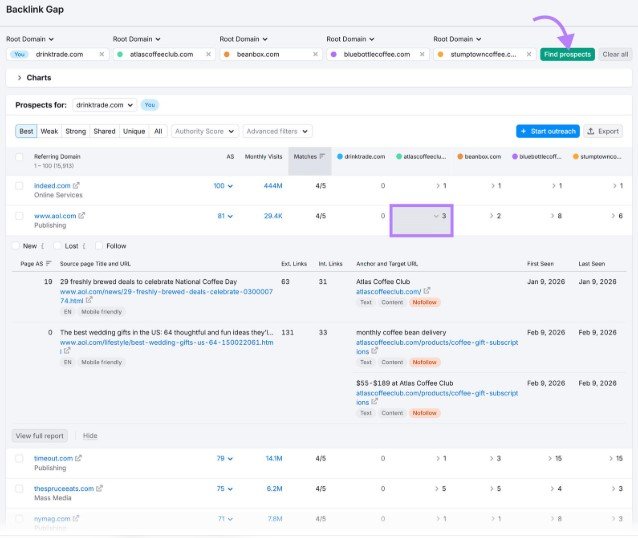
Open your chosen backlink analysis tool and enter your domain alongside your competitors’ domains.
Look for a feature called Backlink Gap, Link Intersect, or a similar comparison report. The exact name and available filters depend on the tool.
The report may show domains that link to one or more competitors but do not link to your website.
Export the results if the tool allows it.
At this stage, do not immediately contact every website. The report is a starting list, not a list of approved prospects.
Also, remember that backlink tools maintain their own databases. Their results may differ from Google Search Console, and neither database should be assumed to contain every backlink on the web.
Step 3: Separate useful opportunities from irrelevant links
This is one of the most important parts of the process.
A competitor might have thousands of backlinks, but only a small portion may be relevant to your business.
Review each prospect and ask:
- Does the website publish content related to my industry?
- Is the linking page relevant to the topic I want to promote?
- Does the website appear to publish genuine, useful content?
- Is there a legitimate reason for the publisher to reference my website?
- Can I offer something useful to that audience?
For example, a link from an SEO tutorial that references a helpful backlink analysis guide may be relevant to an SEO agency.
A link from an unrelated website with no meaningful connection to your topic may not be worth pursuing, even if its reported authority metrics are high.
Do not reject every website outside your exact niche automatically. Broader marketing publications can still be relevant when the article, audience, and link context make sense.
Step 4: Identify why the competitor received the link
Finding a missing backlink is only half the job. You also need to understand why the competitor earned it.
Open the actual page containing the competitor’s link and inspect the surrounding content.
Common reasons include:
Editorial references: The competitor published information that an author considered useful enough to cite.
Original research or statistics: A website referenced a study, survey, or dataset.
Helpful resources: The competitor created a guide, checklist, template, or tool that readers could use.
Expert contributions: A publisher quoted the competitor’s team or included its experts in an article.
Business mentions: A publication covered the company, its product, or an industry contribution.
The reason behind the link should guide your next action.
If a competitor earned a link because it published original research, sending a generic guest-post pitch is unlikely to address the publisher’s original reason for linking.
Instead, consider whether you can provide useful data, a better resource, a relevant expert comment, or another contribution that genuinely fits the article.
Step 5: Find a legitimate way to earn the link
Once you understand why the competitor received the backlink, decide whether you have a suitable opportunity.
Here are several approaches.
Create a more useful resource. If a publisher references a competitor’s guide, consider creating a resource that offers additional practical value, clearer instructions, original examples, or updated information. Contact the publisher only if your resource genuinely improves the reader’s experience.
Suggest a relevant resource. If a page contains a useful resource list and your content fits the same purpose, introduce your resource to the editor. Do not assume the editor must add your link.
Contribute expert information. If an article would benefit from specialist insight, offer a useful contribution based on your actual experience.
Pitch a relevant guest article. When a publisher accepts external contributions, propose a topic that fits its audience and editorial standards. The article should be useful on its own rather than written solely to obtain a backlink.
Build relationships with publishers. When a website consistently publishes relevant industry content, a professional relationship can lead to future editorial opportunities.
Avoid automated mass outreach, fabricated expertise, or paying for links intended to manipulate search rankings. A backlink gap is an opportunity to investigate-not a reason to demand or manufacture a link.
If you pay for a link placement, follow Google’s guidance on qualifying outbound links to ensure paid links are appropriately identified using rel=”sponsored” or other applicable link attributes.
When a relevant publisher accepts external contributions, guest posting can be one way to share useful expertise and reach a relevant audience.
Step 6: Prioritize prospects using a simple scoring system

After reviewing the websites, rank them according to their potential value.
You can use the following internal scoring model. It is a practical prioritization method, not an official Google ranking formula.
Give each prospect a score from 0 to 2 in five categories:
- Topical relevance: Does the website and linking page fit your topic?
- Editorial quality: Does the website publish useful, credible content?
- Audience fit: Would its readers benefit from your resource or expertise?
- Link opportunity: Is there a realistic, legitimate reason for a link?
- Outreach fit: Can you contact the appropriate editor or publisher with a relevant proposal?
Add the scores to get a total out of 10.
A prospect scoring 8–10 may deserve early attention. A prospect scoring 5–7 may need further review. A prospect scoring below 5 should usually be deprioritized until you have a stronger reason to pursue it.
These thresholds are only workflow guidelines. A low score in a critical area, such as relevance or editorial quality, can be a reason to reject a prospect regardless of its total.
Do not use Domain Authority or Domain Rating as a substitute for this review. They are third-party metrics, not direct Google ranking factors.
Step 7: Organize the results in a spreadsheet

A spreadsheet makes it easier to track opportunities and avoid contacting the same publisher repeatedly.
Use these columns:
| Field | What to record |
|---|---|
| Referring domain | Website that links to a competitor |
| Competitor URL | Competitor page receiving the link |
| Your target page | Page you may want to promote |
| Linking page | Exact page containing the competitor’s link |
| Topic relevance | High, medium, or low |
| Link reason | Editorial citation, resource, guest article, and so on |
| Opportunity type | Resource suggestion, expert contribution, guest article, etc. |
| Priority score | Your score out of 10 |
| Contact details | Verified editor or publisher contact |
| Outreach status | Not contacted, contacted, replied, or closed |
| Next action | Follow-up date or required task |
Record the exact linking page whenever possible. A referring domain alone does not explain why a competitor received the link or whether the same opportunity makes sense for your website.
Step 8: Contact the right person with a relevant message
Your outreach message should explain why you are contacting that publisher and what value you can offer.
Avoid messages that simply say, “Your website links to my competitor, so please link to us too.”
A better approach is to reference the specific article, explain how your resource or contribution could help its readers, and leave the decision to the editor.
For example:
Subject: A resource suggestion for your article on backlink analysis
Hello [Name],
I came across your article on [Topic] and found the section about [Specific Subject] useful.
I work with Zenith Reach Agency, where we focus on SEO outreach and link-building resources. We have a guide on [Relevant Topic] that may be useful to readers who want to understand this process in more detail.
Here is the resource for your review: [Your URL]
If you feel it adds value to the article, please feel free to consider it. Either way, thank you for putting together the resource.
Best regards,
Muhammad Zain Anjum
Zenith Reach Agency
Personalize this message before sending it. Do not claim to have reviewed an article unless you have actually done so, and do not send the same generic pitch to hundreds of publishers.
Step 9: Measure the results
A backlink gap analysis should lead to better decisions, not just a longer spreadsheet.
Track the number of relevant prospects identified, outreach messages sent, genuine responses received, editorial links earned, and referring domains gained.
You can also monitor the organic performance of the pages you are promoting in Google Search Console.
However, do not assume that every new backlink will increase rankings. Search performance is affected by many factors, and the impact of individual links is not always measurable.
Review the results periodically and adjust your approach based on the quality of the opportunities and the responses you receive.
A Practical Example of Backlink Gap Analysis
Imagine Zenith Reach Agency wants to improve the visibility of an article about competitor backlink analysis.
The team identifies three websites that publish similar SEO content and compares their referring domains.
The analysis reveals that several SEO publications link to competing guides about backlink research. The team reviews those pages and finds that some links cite original research, while others appear in general resource lists.
Instead of contacting every website, the team divides the prospects into three groups:
- Group A: Relevant publications that cite useful research or guides.
- Group B: Resource pages where a genuinely useful guide could fit.
- Group C: Websites with weak topical relevance or no clear editorial opportunity.
The team prioritizes Group A and Group B, develops a relevant outreach proposal, and tracks responses.
This approach does not guarantee backlinks or higher rankings. It does, however, give the team a more focused process than sending generic pitches to every domain that links to a competitor.
Common Backlink Gap Analysis Mistakes to Avoid
Choosing competitors based only on authority metrics
A high Domain Rating does not automatically make a website a useful competitor or link prospect. Choose websites based on search relevance and the topics you want to rank for.
Copying every competitor backlink
Some competitor links may be irrelevant, outdated, user-generated, or unsuitable for your website. Evaluate the linking page before pursuing an opportunity.
Ignoring the reason behind a backlink
A competitor may have earned a link through original research, a genuine partnership, or a useful resource. Understand the context before deciding how to approach the publisher.
Focusing only on the number of links
Ten relevant, editorially earned links may offer more meaningful value than hundreds of unrelated links. Quality, context, and relevance matter.
Treating paid links as ordinary editorial links
Buying links that pass ranking credit can violate Google’s link spam policies. Paid placements should be properly qualified, such as with rel="sponsored" where applicable. Do not use a competitor’s backlink profile as a reason to replicate manipulative link-building practices.
Expecting immediate ranking improvements
Backlink analysis is a research process, not a shortcut to rankings. Results depend on competition, content quality, site health, search intent, and many other factors.
Final Thoughts
A backlink gap analysis helps you discover where competitors are earning links and identify opportunities that may be relevant to your own website.
The most effective process is straightforward: choose relevant competitors, compare their backlink profiles, inspect the pages that link to them, understand why those links exist, and prioritize opportunities that offer genuine value to readers.
For Zenith Reach Agency, this approach can also help identify relevant SEO publications, digital marketing blogs, and industry websites for future outreach.
Remember that the objective is not to reproduce every competitor backlink. It is to build a stronger, more relevant backlink profile through useful content, genuine relationships, and thoughtful outreach.
Start with a small list of well-qualified prospects, review the results, and improve your process over time. If you want to understand the process in more detail, read our guide to competitor backlink analysis for practical ways to evaluate competing websites’ backlink profiles.

Leave a Reply